Working calculators. Real case results. Sample Action Plans and onsite agendas from actual Pinnacle engagements. Everything we'd hand you on Day One, available to walk through right now.
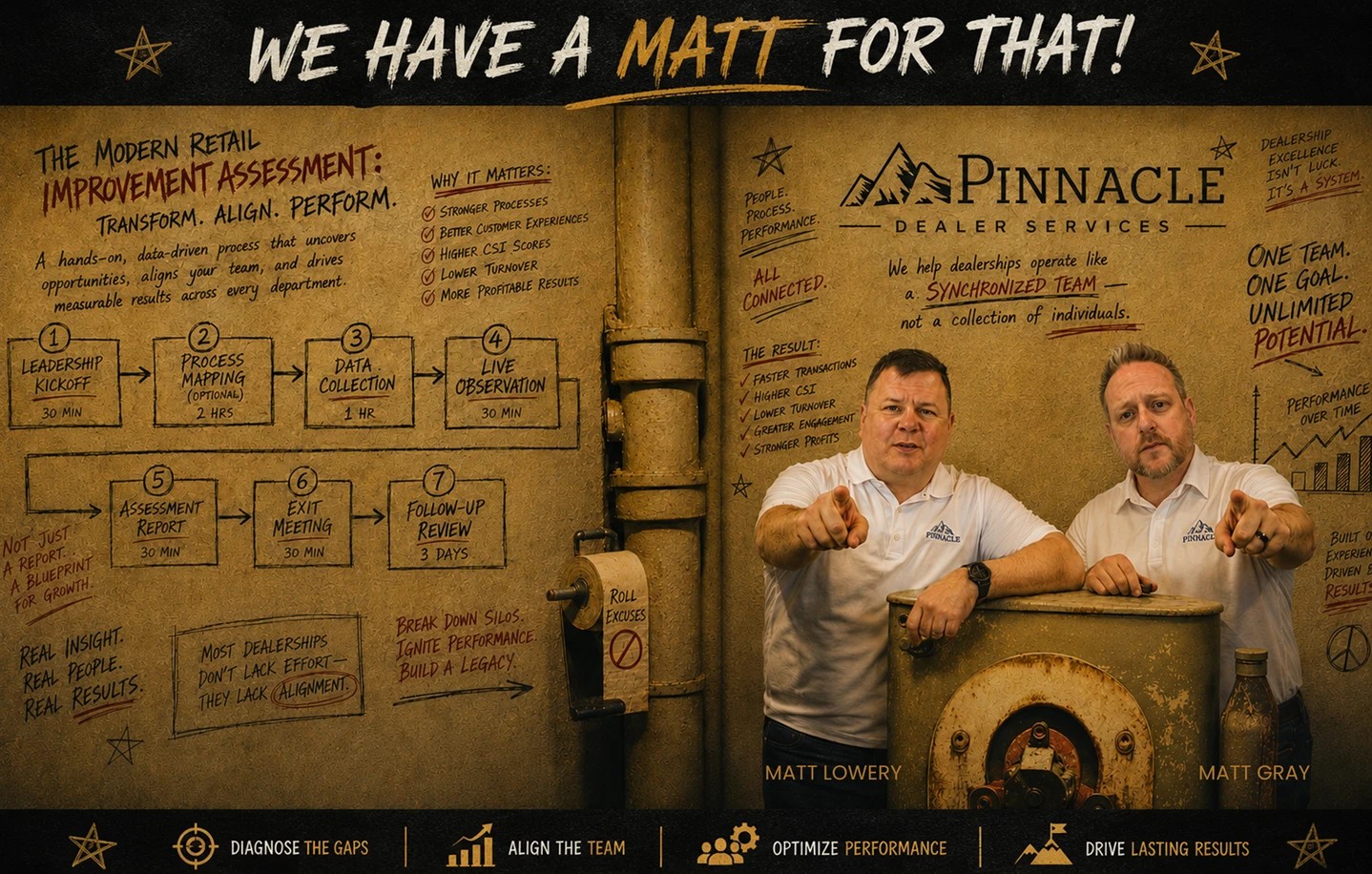
The Modern Retail Improvement Assessment is a hands-on, data-driven process that uncovers opportunities, aligns your team, and drives measurable results across every department. Diagnose the gaps, align the team, optimize performance, drive lasting results. We have a Matt for that.
Tap to open full size.
The daily activity and appointment-set targets your BDC needs to hit your monthly goal. Adjust the inputs to match your numbers, the math updates live.
A real-world Pinnacle engagement. Baseline June 2025, results July–November 2025. The store didn't add headcount, technology, or budget. They fixed the operating system around what they already had.
Internet close rate climbed from 6% to 11% with no regression. Phone-up sold rate up 47%. Days-to-sale dropped 43%. +145 more sales versus last year. The transformation was operational, not technological, and that's the model behind every Pinnacle engagement.
"The trajectory shows steady improvement with no regression, a sign that process changes are sticking and the team is building sustainable habits, not just hitting short-term spikes."
After every onsite coaching visit, your store receives a written, prioritized Action Plan. KPI snapshot at the top. Specific items tagged by category and tracked visit-to-visit. Nothing falls off the plan until it's delivered.
BDM must be physically located inside the BDC to manage the room, take T.O.'s, monitor activity and results in real time, and provide immediate coaching. This single change enables all other process improvements by creating constant management presence and accountability.
Mandatory T.O. for all fresh leads (internet and phone) that were contacted but remain unappointed. BDM takes at least two T.O.'s per BDR per day. Prioritize live T.O.'s when possible; if unable, BDM conducts a follow-up call within 15 minutes. Treat with the same urgency as a showroom T.O. Deals are hiding in these unappointed leads.
Daily BDR scorecard establishing MAP (Minimum Acceptable Performance), PAR, and TARGET goals focused on fundamental KPIs: Activity, Contacts, Appointment Rate, Appointment Show Rate. Use the Goal Calculator to determine the BDC contribution goal for monthly appointments and sales. Consider tying to compensation with individual and team-based components.
Complete overhaul of all email and text templates. Remove all "if" statements and replace with motivational calls-to-action. Create templates targeted to where the customer is in the buying journey: selecting inventory, credit concerns, trade questions. Journey-stage templates create more relevant communication and help identify which step is blocking the customer.
Update CRM follow-up processes for fresh leads to make multiple contact attempts during the first 72 hours. Assign call, text, and email tasks during this critical window. Days 3-6 are the highest defection risk, so heavy, multi-channel contact during this period prevents competitor capture.
Modify CRM to trigger a missed-appointment task 15-30 minutes after appointment time. Product Specialist calls within 30 minutes, BDC follows up 2 hours later. Speed of recovery directly impacts reschedule rate.
Rather than marking leads "Auto Lost" after 30-60 days, build a long-term follow-up: monthly newsletter with new inventory, trade evaluation link, and service specials to drive re-engagement. Run long-term follow-up for 90-180 days before marking lost. Recovers deals that would otherwise disappear.
Establish a process to start and stop showroom visits in the CRM in real time. Receptionist starts the visit when greeting the customer on arrival. Critical for accurate missed-appointment follow-up and unsold showroom traffic follow-up. Without real-time tracking, follow-up timing is guesswork.
BDM is responsible for clearing "Active Leads without Future Follow-Up" in the CRM daily, ensuring every lead is placed into the correct follow-up process. Leads in this bucket are invisible to the team and represent lost opportunities. A non-negotiable daily discipline.
Train the team to use AI tools to create personalized template responses with customer-specific details, compelling text messages, email responses addressing specific questions, and phone scripts for different scenarios. Personalization at scale, without requiring individual writing skill from every team member.
Weekly review of every lead where contact was made but no appointment was set. Carried from Visit 3. Cadence holding; review continuing into Visit 5.
Completed between Visit 3 and Visit 4. Texting is now native in the CRM, customer history is captured in the conversation thread, and Podium is retired. Confirmed compliance with TCPA template review.
How the categories work. Critical items move first. Efficiency closes time and process gaps. Foundation builds the systems behind the work. Growth adds capability for the next quarter. Status: Carry from a prior visit, Delivered completed.
Every onsite visit follows the same operating rhythm, accountability audits, live observation, role-play with named reps, and an exit meeting with a written plan. Each session is tagged by category so leadership knows exactly what's being worked on and why.
Review the prior visit's action items, mark what is delivered, in progress, or carried forward. Review KPI deltas vs the Assessment baseline. Set the tone for the visit.
Verify 30-minute response-window enforcement. Check the lead reassignment process when a salesperson does not respond within the window. Review the CRM for any remaining delays caused by holding leads until after the sales meeting. Confirm the process is eliminating first-contact delays.
Evaluate BDM adherence to a structured daily schedule: morning huddle with prior-day metrics, scheduled coaching sessions, a midday CRM audit, and an end-of-day checkpoint. Assess personal activity completion against the 25-50+ daily activity target. Is the schedule documented, visible, and consistently followed?
Monitor appointment-setting quality and objection handling on live calls. Evaluate used-vehicle value positioning: quality, certification, and financing advantages vs competing on price alone. Coach on T.O. process execution for unappointed phone-ups. BDM should be taking a minimum of 2 T.O.s per BDR per day.
Cross-reference the CRM desk log, inbound call logs, and showroom traffic logs to identify under-logged phone-ups. Verify every customer interaction is logged with the correct source and timestamp. Implement a standardized process for how and when to log walk-ins and phone-ups. Review weekly lead-source reporting for accuracy.
Summarize Day 1 findings: lead-response compliance, BDM schedule adherence, and lead-source data observations. Align on Day 2 priorities.
Review the BDC activity dashboard completion and review process. Verify consistent physical BDM presence in the BDC, active coaching, daily 1:1 side-by-side coaching, and monthly evaluations. Review key activity metrics against goals: tracking is sustainable, accurate, and ongoing.
Audit used-vehicle response templates for value differentiation from new-vehicle messaging. Coach on brand-promise positioning for price objections on pre-owned inventory. Confirm SEO and hours messaging are incorporated. The 20-30 day rollout window is underway.
Review a targeted outbound campaign using available CRM Rewards points to drive immediate service and sales opportunities. Evaluate the high-value truck campaign developed with supporting call guides and templates. Measure early results from campaigns deployed during Visit 4.
Reinforce live coaching on building the phone-skills library for common objections. Review confirmation calls that confirm the customer on the showroom day and time. Capture recordings for the new BDC playback library.
Strengthen alignment between BDC and sales management. Reinforce shared responsibility for appointment outcomes and showroom traffic. Ensure a seamless handoff process and a matching conversion from lead to sale.
Present final visit findings, status updates on prior Visit 4 action items, and the written Action Plan for Visit 6. Confirm the next visit date and its priorities. Get signoff on coaching commitments and timeline.
Session categories. Accountability verifies process adherence. Coaching is direct rep-level skill building. Process covers systems and workflow. Benchmark measures against targets. Assessment reviews progress vs baseline.
An actual Engagement Intelligence comp shop, same vehicle, same customer question, two dealerships, full timeline of every touch captured and scored. This is what you'd receive on your store.
200/200 vs 155/200. Per-criterion scorecards. Full email + call + text timeline. Side-by-side IQR analysis. Six-item action plan tied to named behaviors. The structure and depth match every report Pinnacle delivers.
One-page briefs for each capability bundle. Designed to share with leadership, drop in a procurement folder, or hand a GM at a conference.
A fully trained BDC, without building one. Coverage matrix, the same-coaches differentiator, what's delivered.
Download PDFAn embedded performance coach. Diagnose, fix, sustain, visit by visit, item by item, until it's delivered.
Download PDFReal-time call visibility. PAM with built-in AI. Engagement Intelligence shops. See it. Manage it. Validate it.
Download PDFSame Action Plan structure. Same coaching cadence. Same operating system that drove Toyota of Katy's $535K.